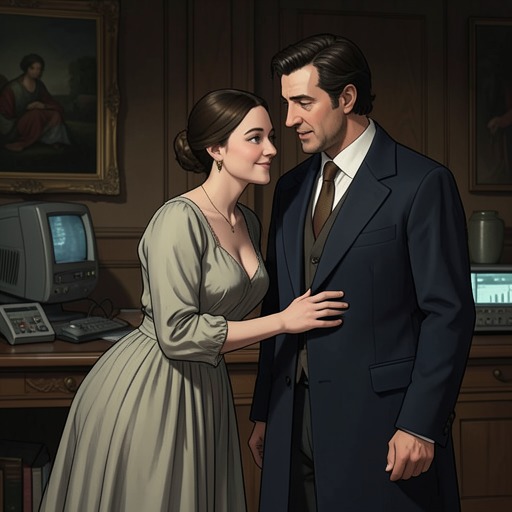
M. de Charlus chooses a rendezvous with the bus conductor over the Princess’s appeal
In Search of Lost TimeM. de Charlus chooses a rendezvous arranged by Jupien with a bus conductor over the Princesse de Guermantes’s desperate appeal for his help. The episode’s decisive reversal is not simply that the Baron refuses the Princess: he turns away for an introduction to a stranger he has never met, while retaining the manners and forms of address through which he ordinarily presents himself to the world.
The Princess’s appeal and the messages
The Princess knows that the First-person narrator often sees M. de Charlus. When she expects the narrator to visit, she discreetly asks questions that appear casual but are meant to check the Baron’s explanations about particular addresses or evenings. Sometimes she asks nothing during the visit, only to pose several questions at the door after the narrator has said goodbye. This pattern of indirect inquiry precedes the evening’s urgent appeal.
On this occasion, the Princess summons the narrator in a state of extraordinary agitation and asks him to carry a letter to M. de Charlus at all costs. The narrator finds the Baron at home, attending to his appearance before a mirror. He reads the letter, which the narrator later learns was a desperate appeal, but asks the narrator to report that he is ill and cannot come that evening. The refusal is therefore conveyed not directly to the Princess but through the same intermediary she has asked to help her reach him.
Preparation for a different meeting
While giving his answer, M. de Charlus selects roses from a vase, trying flowers of different colors in his buttonhole and checking them against his complexion in the mirror. His preparations are interrupted when his valet announces that the barber has arrived but has forgotten his curling tongs. The Baron grows angry, then worries that without the tongs his hair will be less wavy and his face flushed. He says he must leave within half an hour or miss everything.
The contrast makes his priorities legible through practical detail: he has declined the Princess’s appeal, yet his departure remains urgent and his appearance remains a matter of concern. The narrator leaves and returns to the Princess. She writes another message, acknowledges that she is taking advantage of his friendship, and asks him to go back to M. de Charlus once more.
The rendezvous with Jupien
As the narrator approaches the Baron’s house again, he sees M. de Charlus join Jupien beside a parked cab. The headlights of a passing car briefly reveal a bus conductor’s cap and face. To avoid being seen, the narrator turns into a dark, unlit cul-de-sac. There, M. de Charlus checks with Jupien that his moustache is in order and asks what the man he is going to meet is like. Jupien reassures him that the stranger is of the Baron’s preferred type.
From this exchange the narrator understands the nature of the choice: M. de Charlus is not missing the Princess’s appeal to meet someone he already loves or desires, but to accept an arranged introduction to someone he has never met. The rendezvous is thus presented as an immediate, particular alternative to the Princess’s urgent request, not as an obligation to an established attachment.
The returned letter and a second delay
The narrator goes back to the Princess with her second letter still undelivered. Disappointed, she bursts out angrily at him, then apologizes and says she hardly dares ask him to return a third time. He nevertheless goes back to the cul-de-sac. The cab is still there, and M. de Charlus is discussing the arrangements for the conductor’s departure and a future meeting. He proposes that Jupien leave with the man and see him on his way, then asks how they should arrange to meet again. The conductor suggests sending a message when he goes out for a meal at noon; M. de Charlus instead says it would be simpler for the conductor to arrange it with Jupien.
The narrator’s repeated journeys frame the refusal as an unfolding choice: each return brings a further attempt by the Princess to reach the Baron, while M. de Charlus remains occupied with the rendezvous. The conductor’s reference to a noon meal does not neatly fit the Baron’s own way of life. The narration treats this mismatch as a difference of social world rather than a failure to understand: M. de Charlus accepts the proposed arrangement, but redirects its practical details through Jupien.
Courtesy, habit, and social performance
Even in the cul-de-sac, M. de Charlus closes the meeting with formal politeness, calling it delightful and retaining his aristocratic hauteur. The narrator observes that he may be more ceremonious outside society than within it: when people leave familiar surroundings, they fall back on remembered habits, so that the very actions through which they seem to depart from their accustomed world are shaped by it. The Baron’s courteous manner therefore persists alongside a meeting that takes him beyond his regular social sphere.
The episode also recalls how political belief and private life can be read together, whether accurately or not. Elsewhere, anti-Dreyfusards exploit the Princesse de Guermantes’s German origin and her love for M. de Charlus to undermine the Prince de Guermantes’s support for Dreyfus, although the narrative stresses that his political position was not caused by his wife or the Baron’s sexual proclivities. Against that public climate, the Princess’s private appeal and M. de Charlus’s refusal reveal a different kind of disconnect: public identity, political interpretation, personal attachment, and immediate desire do not necessarily align. The scene leaves the Princess’s distress unresolved and ends with the Baron’s meeting arranged on its own terms.